
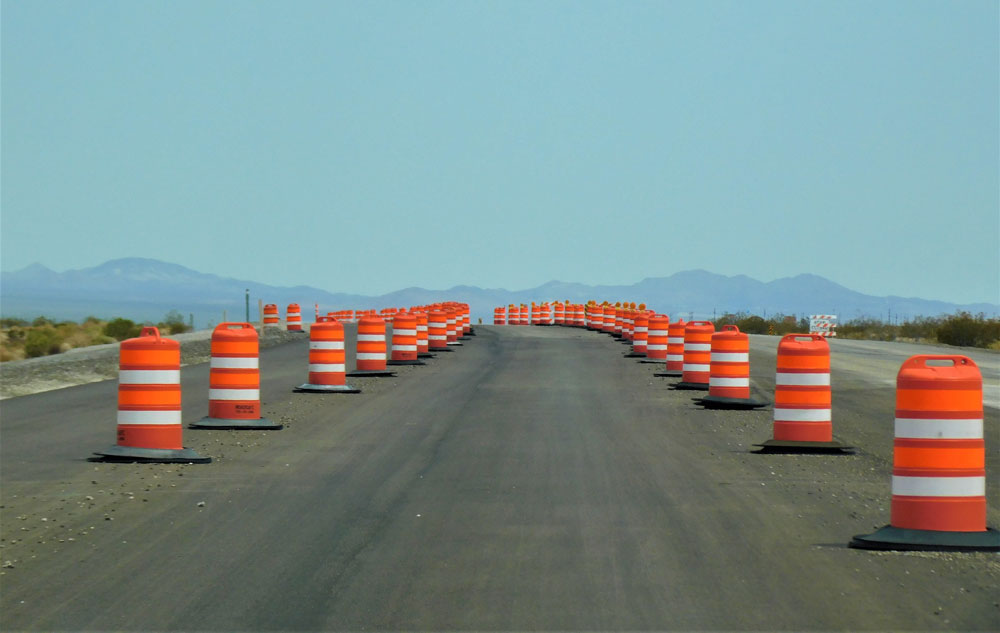
Work zones are complex environments filled with workers, equipment, changing lane patterns, and temporary hazards. Yet far too many crews assume that motorists instinctively understand what to do when they enter a work zone. They do not. A driver should never have to guess which lane to be in, where to stop, or how to move through the area. Drivers are not mind readers, and in today’s era of built in distractions, unclear work zones are an invitation for accidents.
Every safe work zone begins with one principle: guide and control motorists. Clear, physical direction keeps both workers and road users safe. Relying solely on a flagger’s judgment or hoping drivers “figure it out” is not a safe strategy.
Vehicles are full of screens, alerts, integrated apps, and features competing for a driver’s attention. Even diligent drivers are more distracted than they used to be. At the same time, many motorists encounter work zones infrequently, meaning they may not understand temporary traffic patterns or the intent behind certain layouts.
Expecting drivers to interpret an unmarked gap or predict a lane shift is unreasonable. Workers on the ground understand the site’s layout. Drivers approaching at speed do not.
When work zones lack visible, structured guidance, drivers hesitate. Hesitation leads to sudden braking, lane drifting, and last second corrections. This unpredictability creates significant danger for crews standing only a few feet from moving traffic.
Clear guidance reduces:
Sudden maneuvers
Driver confusion
Close calls for workers
Rear end collisions
Aggressive behavior from frustrated motorists
A well designed work zone removes uncertainty and forces compliance with the intended path.
Traffic cones, barrels, barricades, temporary rumble strips, and arrow boards are not optional. They are the foundation of directing motorists safely around or through a work zone. These devices communicate far more reliably than hand gestures or assumptions.
Best practices include:
Create a fully defined taper with cones, not a partial one.
Use channelizers to maintain the lane so drivers are guided end to end.
Place cones consistently with proper spacing to avoid gaps that look like entrances.
Deploy advance warning signs well before the lane shift or flagger station.
Use an arrow board for lane closures or merges at higher speeds.
Mark the stopping point clearly, either with a cone line or a flagger positioned where the stop must occur.
If a motorist can accidentally enter the work area, the layout needs improvement.
A simple rule should apply to every work zone: If a driver has to think about where to go, the work zone is not set up correctly.
A driver should never wonder:
Am I supposed to be in this lane?
Is this a gap or an entrance?
Do I stop here or further up?
Can I drive past that equipment?
Motorists must be physically guided so that the intended path is the obvious path.
Flaggers are important, but they cannot be everywhere at once and their signals can be hard to see during bright sunlight, fog, or heavy traffic. Flags and paddles support safety, but cones and channelizing devices define safety.
A flagger’s job becomes easier and safer when the work zone is already doing most of the communication.
Supervisors and crew leaders should regularly walk or drive the work zone from a motorist’s perspective. Approaching the site at road speed reveals problems that workers often overlook because they are familiar with the layout.
Ask:
Does the taper lead naturally into the intended lane?
Is there any point where a driver might misunderstand?
Are signs blocked by parked equipment or vegetation?
This self assessment keeps standards high and prevents complacency.
Work zones are only safe when drivers are guided with physical clarity. Never assume motorists understand what you understand. They do not see the work from the crew’s perspective, and they are often distracted before they even enter the zone.
Define everything. Guide everything. Control everything.
When cones, signs, and devices lead motorists with absolute clarity, crews stay safer and work zones run smoother.