
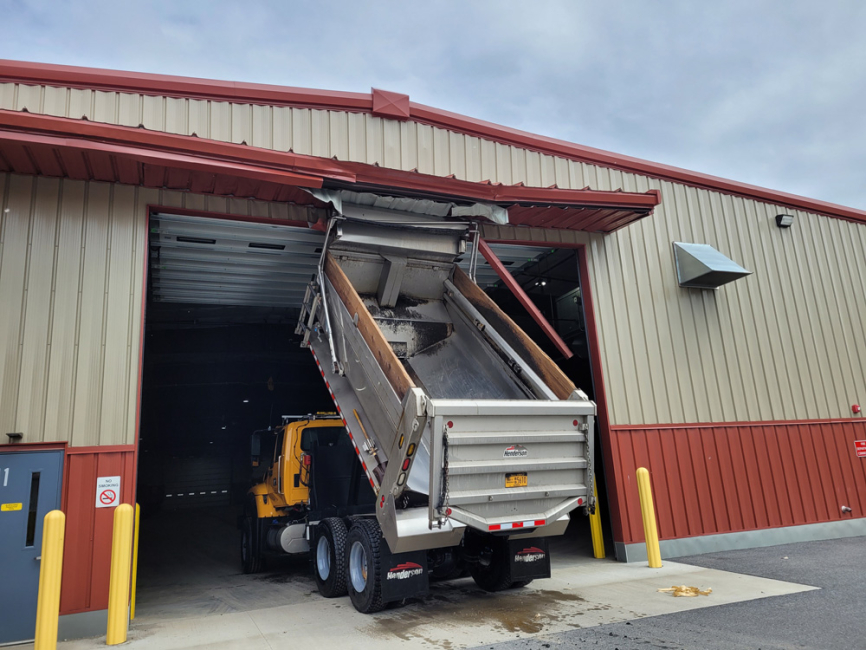
*The above image was taken at the Queensbury Highway Department in upstate New York. The driver had just finished washing out the dump body on the truck and was returning it to the garage. This truck was manufactured with a dump body-up light, but no audible alarm. It may look as if they merely needed to replace a few sheets of aluminum siding, but the accident caused nearly $200,000 of damage to the three year-old structure and around $60,000 of damage to the truck.
In public works operations, few accidents are as preventable, and as costly, as a dump truck striking a structure with its body raised. These incidents often occur in familiar environments such as garages, salt sheds, or maintenance facilities where drivers feel comfortable and routine takes over. Unfortunately, that sense of familiarity can lead to complacency, and the results can be catastrophic. A single oversight can result in severe structural damage, costly equipment repairs, and significant downtime that disrupts operations.
Dump body-up alarms exist specifically to prevent these incidents. They are a simple but highly effective safety device designed to alert the operator when the dump body is not fully lowered. Typically triggered when the ignition is engaged or when the transmission is shifted into gear, these alarms provide an audible warning that something is wrong before the truck begins moving. In many cases, that brief moment of awareness is all it takes to prevent a major accident. Please note that many dump body-up alarms alert even when the truck is in neutral.
The real-world consequences of ignoring or disabling these alarms are substantial. When a raised dump body strikes a garage door header or overhead structure, the force involved is immense. Structural steel can be bent or torn, masonry can be compromised, and entire sections of a building may require reconstruction. On the vehicle side, hydraulic cylinders, hoists, and the dump body itself can sustain severe damage. It is not uncommon for total losses from a single incident to exceed hundreds of thousands of dollars when both facility and equipment repairs are considered, not to mention indirect costs such as lost productivity and emergency response. Also, we have all seen videos on YouTube, if not in person, of the results of a dump body pulling down overhead electrical lines. It's not pretty - and it can be fatal.
Because of the known risks, dump body-up warning devices are not just a best practice. In some jurisdictions, they are legally required on dump trucks and similar equipment. Regulations may mandate that vehicles be equipped with functional warning systems that activate when the dump body is elevated. Failing to maintain these systems in working order can expose municipalities and contractors to regulatory penalties, liability claims, and increased scrutiny following an incident.
Despite their importance, these alarms are often intentionally disabled or tampered with. Drivers may find the constant audible warning irritating, particularly during activities like washing out the dump body or when operating with the box raised for paving operations. In some cases, wires are cut, buzzers are removed, or switches are bypassed to silence the alarm. While this may seem like a minor convenience in the moment, it eliminates a critical safeguard and significantly increases the likelihood of a serious accident.
Supervisors and fleet managers must take a firm stance against any tampering with safety devices. A dump body-up alarm should be treated the same as any other essential safety feature such as brakes or backup alarms. Routine inspections should include verification that the alarm is present, functional, and has not been altered. Any deficiencies should be corrected immediately, and deliberate tampering should be addressed through disciplinary policies. Just as importantly, crews should be trained to understand why the alarm exists and how quickly a momentary lapse can lead to a major loss.
Building a strong safety culture around this issue means reinforcing a simple habit. Before moving a dump truck, the operator must confirm that the body is fully lowered. The alarm serves as a backup to that habit, not a replacement for it. When both human awareness and mechanical warning systems are working together, the risk of these incidents drops dramatically.
In public works, where budgets are tight and infrastructure is critical, preventable losses of this magnitude are especially damaging. Dump body-up alarms are a low-cost, high-impact safety measure that protects facilities, equipment, and personnel. Ensuring they are installed, maintained, and respected is not just good practice. It is essential risk management.