
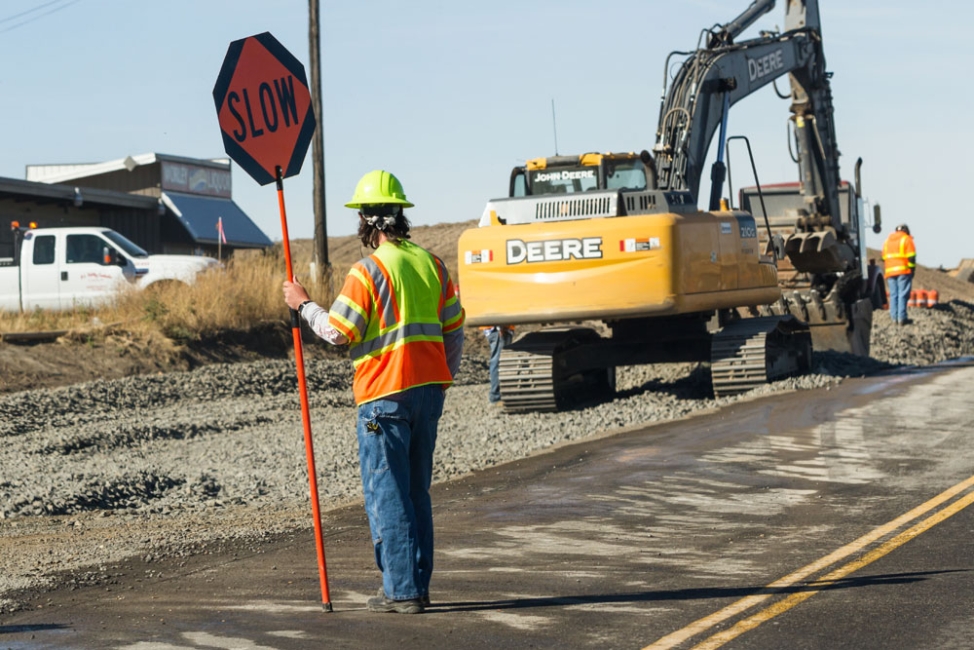
When heavy equipment moves, it does more than travel forward and backward. Machines like excavators, backhoes, loaders, and cranes also rotate, pivot, and swing large components that can strike workers who are standing too close. These movements create what are known as swing zones. Understanding where these zones are, how they change during operation, and how to control the space around equipment is a cornerstone of public works safety.
A swing zone is the full area that a piece of equipment can sweep through when it rotates or pivots. For example, an excavator’s upper structure can rotate a full 360 degrees. The bucket, stick, and boom also move through large arcs. Combined, this creates a danger area that is much larger than most workers realize.
Other equipment has similar hazards. Backhoes have overlapping swing areas between the hoe and the loader bucket. Compact track loaders can pivot quickly and unpredictably. Even loaders without upper rotation still create swing hazards with their arms and buckets.
"Struck by" incidents are one of the most common and most severe causes of injury in public works. The danger increases because swing movements often occur while the operator is focused on the task, not on the people behind or beside them. Ground crews may also assume they are visible when they are not, especially when standing low or near blind spots.
The forces involved in even slow equipment movement can cause catastrophic injuries. A simple tail swing can knock a worker down, pin them against a solid object, or pull them into the machine’s path.
To stay safe, crews must be able to visualize the danger area. Key steps include:
A good rule of thumb is to imagine the equipment drawing a full circle around itself, then add several feet to allow for unpredictable movement.
Use cones, signs, or barriers to mark the minimum safe distance. Many departments use 20 to 25 feet as a baseline, but this depends on equipment size. The zone should extend in all directions, not just the front or rear.
A trained spotter should maintain visual contact with both the operator and the crew. The spotter’s job is to enforce the exclusion zone and communicate when someone needs to approach the machine.
Clear communication reduces surprises. Operators should stop movement if they lose sight or radio contact with the spotter.
Operators must always recheck mirrors and surroundings before swinging, not just before driving. Whenever in doubt, they must stop and verify.
Ground crews should never approach a machine from behind or from a blind spot. Instead, they should wait for eye contact, a hand signal, or a radio confirmation from the operator.
Workers should wear clean, reflective vests and stay out of shaded or dusty areas where visibility is reduced.
Crews should plan dig areas, dump areas, truck movement, and foot traffic so that workers are not forced to cross swing paths while equipment is active.
Keeping people clear of swing zones is not a one time conversation. Departments should review incidents, near misses, and daily operations to reinforce good habits. Supervisors and operators must be empowered to stop work anytime the exclusion zone is violated.
The safest job sites are the ones where everyone understands that heavy equipment can move fast, swing wide, and create risks long before anyone hears it coming. By identifying swing zones, marking them clearly, and keeping ground crews out of harm's way, public works teams can significantly reduce struck by incidents and maintain safer work areas for everyone.