
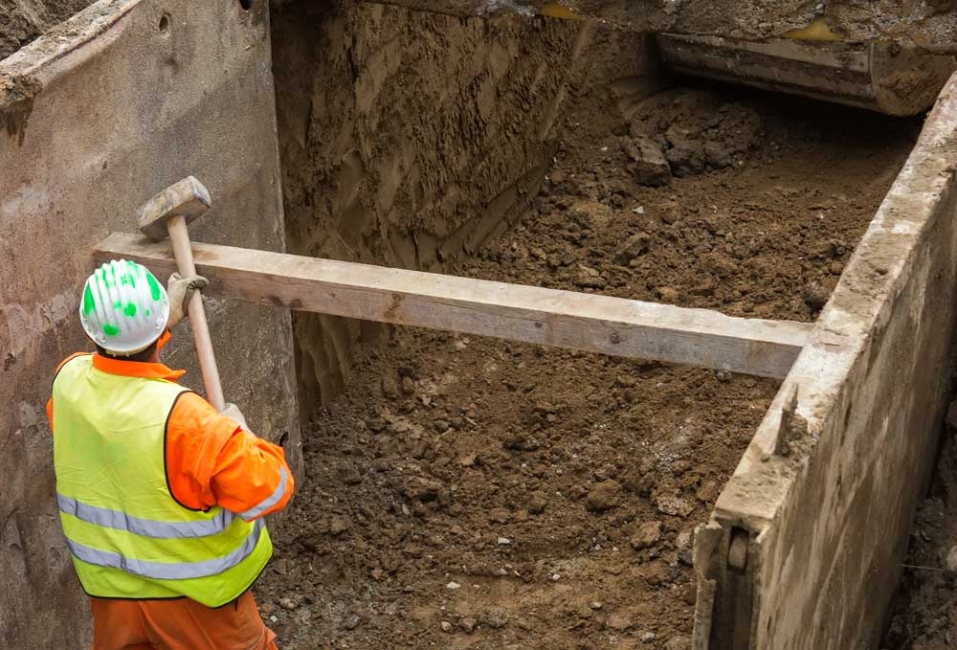
Excavated trenches are a routine part of municipal roadwork, drainage repairs, water-line maintenance, and utility installation. But they are also among the most dangerous places a worker can set foot. Trench collapses occur suddenly, without warning, and with enough force to bury and suffocate a person in seconds. For small public works departments, where crews often multitask and conditions vary widely, it’s critical to understand what a trench is, why it’s dangerous, and when protective systems are legally required.
An excavated trench is defined by OSHA as a narrow underground excavation that is deeper than it is wide, no wider than 15 feet measured at the bottom. Although trenches vary greatly depending on purpose - installing culverts, repairing water services, replacing storm drain lines - the defining characteristic is the same: a deep, confined cut into the earth with limited access and egress.
Trenches can be:
Short or long (from a few feet to hundreds of feet)
Shallow or very deep
Temporary (for a single repair)
Part of ongoing construction (utility or drainage installation)
Regardless of purpose, once you disturb the soil, you introduce a risk of collapse.
Even small trenches exert massive lateral pressure on their walls. Soil that appears stable can shift without warning; such as, especially after rain, vibrations from traffic, or freeze–thaw cycles. Workers inside a trench have little room to move and almost no chance to escape in time.
A cubic yard of soil weighs 2,500-3,000 pounds - roughly the weight of a small car. When trench walls fail, they fall inward instantly and with crushing force.
Especially in deeper trenches, stormwater structures, clay soils, or areas with decomposing organic matter, poor ventilation can cause:
Low oxygen
Methane buildup
Hydrogen sulfide and sewer gases
Gas monitors should be used whenever conditions are uncertain.
Tools, pipes, bucket spill, or spoil piles placed too close to the edge can fall into the trench and strike workers.
Groundwater, leaks, and rain dramatically increase collapse risk and can drown or trap workers.
Trenches can quickly become confined spaces with only one way out; a serious problem if a collapse occurs or a hazardous atmosphere is detected.
OSHA requires protective systems - including trench boxes, shoring, or sloping - for any trench 5 feet (1.52 m) deep or deeper, unless the excavation is in stable rock (rare in municipal work).
5 feet deep or greater → A trench box or other protective system is required.
Less than 5 feet → A competent person must decide if protection is still required.
(Many collapses occur in trenches shallower than 5 feet.)
20 feet or deeper → A professional engineer must design or approve the protective system.
Ladders or safe exit points must be located within 25 feet of every worker.
Spoil piles and equipment must be kept at least 2 feet back from the edge.
A trench box (also called a trench shield) is a protective structure used to prevent cave-ins from crushing workers. They are typically made of steel or aluminum and come in various sizes to match trench width and depth.
A trench box does not prevent a trench wall from failing; it protects the workers inside when it does.
Depth is 5 feet or more, and the trench cannot be sloped or benched adequately due to space, soil type, or adjacent structures.
Crews are working in unstable soil.
Heavy equipment is operating nearby.
The trench passes through saturated or previously disturbed ground.
OSHA mandates that a competent person must inspect trench conditions daily and after any event that increases collapse risk (rain, freeze–thaw, equipment vibration).
A competent person must:
Know soil classifications
Recognize hazards
Be authorized to stop work and correct unsafe conditions
Most public works departments designate a trained foreman or supervisor for this responsibility.
Trenches are essential for public works operations, but the risks are real and unforgiving. No timetable or emergency repair is worth a life. Using a trench box, monitoring soil conditions, keeping spoil piles set back, and ensuring safe access are straightforward steps that prevent fatal incidents.
Municipal crews should treat every excavation - no matter how routine - as a potential hazard. When in doubt, use a protective system.